

Introduction
Oracle PL/SQL Support Full Stack Development by handling database logic, business rules, and data operations behind web applications. Full Stack developers need strong database skills to build reliable applications.
Moreover, Oracle PL/SQL helps developers create procedures, functions, triggers, and packages inside Oracle Database. These features allow applications to process and manage data efficiently.
For students and job seekers in Chennai, combining database knowledge with Full Stack skills can create a broader technical foundation. Therefore, learning PL/SQL alongside frontend and backend technologies can improve practical project skills.
A Full Stack application usually contains three major areas: frontend, backend, and database. PL/SQL mainly supports the database layer, while backend technologies connect that layer with the application.
Table of Contents
- What is Oracle PL/SQL Support Full Stack Development?
- Why Choose a Oracle PL/SQL Support Full Stack Development in Chennai?
- Key Modules Covered in a Oracle PL/SQL Support Full Stack Development
- Practical Tools You Master in Oracle PL/SQL Support Full Stack Development Training
- How Oracle PL/SQL Connects With Full Stack Applications
- Career Opportunities After Completing a Oracle PL/SQL Support Full Stack Development
- Self-Learning vs. Hands-on Training at Infycle Technologies
- Frequently Asked Questions About Oracle PL/SQL Support Full Stack Development
- Conclusion
- Final CTA
What is Oracle PL/SQL Support Full Stack Development?
Oracle PL/SQL supports Full Stack Development by managing database operations and business logic within Oracle Database.
Simply put, PL/SQL extends SQL with programming features. Developers can use variables, conditions, loops, procedures, functions, cursors, and exception handling.
For example, consider an online shopping application. The frontend displays products, the backend processes requests, and Oracle Database stores customer and product information.
Furthermore, PL/SQL can handle database-side operations required by that application. A procedure could calculate an order total, update inventory, or record a transaction.
This separation helps developers organise application responsibilities. The frontend focuses on user interaction, while the backend manages application requests.
Meanwhile, the database manages persistent information and related operations. As a result, each layer can perform a specific role within the application.
Why Choose a Oracle PL/SQL Support Full Stack Development in Chennai?
Learning database programming alongside Full Stack skills can help Chennai learners understand complete application workflows.
Many beginners focus heavily on frontend development. However, understanding how applications store, retrieve, and process information can provide a stronger development foundation.
For instance, a student building a student management system needs more than HTML and JavaScript. The application also requires a database for student records and backend logic for processing requests.
Therefore, database programming becomes an important part of practical Full Stack learning. Students can understand what happens after a user submits information through a website.
In addition, Chennai offers several technology learning opportunities for students, graduates, and career changers. A structured course can help learners practise concepts instead of only studying theory.
An oracle plsql training in chennai program can introduce database concepts before moving into practical development. Furthermore, combining these skills with Full Stack technologies can support project-based learning.
Key Modules Covered in a Oracle PL/SQL Support Full Stack Development
A practical learning path should cover SQL, PL/SQL programming, database objects, APIs, and application integration.
First, learners should understand SQL fundamentals. SELECT, INSERT, UPDATE, DELETE, joins, subqueries, and aggregate functions provide the foundation.
Next, PL/SQL introduces procedural programming concepts. Variables, conditional statements, loops, cursors, and exception handling help developers create database programs.
Moreover, procedures and functions allow developers to create reusable database logic. Packages can group related procedures and functions into organised units.
Triggers are another important concept. They can automatically execute specific database operations when selected database events occur.
Along with this, learners should understand tables, views, indexes, sequences, constraints, and relationships. These concepts become useful when designing application databases.
Practical Tools You Master in Oracle PL/SQL Support Full Stack Development Training
Practical training should introduce tools that developers use for database development and application projects.
Oracle SQL Developer provides a convenient environment for writing SQL and PL/SQL code. Developers can also inspect database objects and troubleshoot queries.
Furthermore, Visual Studio Code can support frontend and backend development workflows. Git helps developers track changes and manage project versions.
Backend technologies can communicate with Oracle Database through suitable drivers and APIs. Therefore, learners should understand how requests travel between the application and database.
For example, a user may submit a registration form through a React interface. The backend can receive the request and communicate with Oracle Database.
The database can then validate and store the information. As a result, the complete application workflow connects frontend, backend, and database technologies.
How Oracle PL/SQL Connects With Full Stack Applications
Oracle PL/SQL connects with Full Stack applications mainly through backend services that communicate with the database.
A typical application begins with a user action. For instance, a customer may click a Place Order button on an e-commerce website.
The frontend sends the request to the backend. Then, the backend validates the request and communicates with Oracle Database.
Furthermore, the backend can call a PL/SQL procedure to perform database operations. The procedure may check stock, calculate values, update records, and return a result.
The backend then processes that result. Finally, the frontend displays the appropriate message to the customer.
This workflow shows why database knowledge matters to Full Stack developers. Understanding each layer makes debugging and application design easier.
Developers can also separate business logic carefully. Therefore, they can decide which operations belong in the application layer and which operations should remain within the database.
Career Opportunities After Completing a Oracle PL/SQL Support Full Stack Development
Combining Oracle database skills with Full Stack knowledge can open several development-oriented career paths.
Learners can explore roles such as Full Stack Developer, Backend Developer, Oracle Developer, Database Developer, and Software Developer. However, employers usually expect broader technical knowledge for these positions.
For example, Full Stack roles may require HTML, CSS, JavaScript, frontend frameworks, backend programming, databases, APIs, and Git.
Oracle-focused positions may place greater emphasis on SQL, PL/SQL, database design, performance, and enterprise application concepts.
Moreover, project experience can help candidates demonstrate their skills. A student could create an employee management system using a frontend interface, backend service, and Oracle database.
Another useful project could be an e-commerce application. It can include customers, products, orders, payments, and inventory.
Therefore, learners should focus on building working projects rather than memorising commands. Practical experience can also make technical interview discussions easier.
Self-Learning vs. Hands-on Training at Infycle Technologies
Self-learning offers flexibility, while hands-on training provides structured practice and guided support.
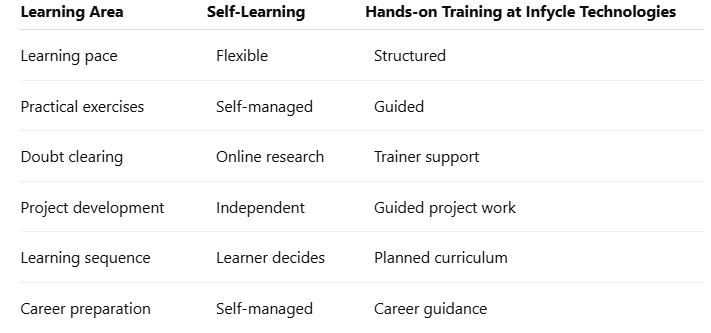
Self-learning can work well for learners who enjoy independent research. However, beginners may spend considerable time resolving technical problems alone.
Hands-on training provides a clearer learning sequence. Moreover, regular exercises can help learners identify weak areas and improve their coding confidence.
Mid-Article CTA
If you want to combine database knowledge with practical Full Stack skills, Infycle Technologies can provide structured learning support.
Moreover, Oracle PL/SQL Support Full Stack Development can be understood through practical projects that connect database operations with application workflows. Explore the Full Stack Developer course in Chennai to learn how frontend, backend, and database technologies work together.
Frequently Asked Questions About Oracle PL/SQL Support Full Stack Development
Can Oracle PL/SQL help a Full Stack Developer?
Yes. Oracle PL/SQL Support Full Stack Development by strengthening database programming and data-management skills.
Should Full Stack Developers learn PL/SQL?
Learning PL/SQL can be useful when projects use Oracle Database. Furthermore, database knowledge helps developers understand application data flows.
Is PL/SQL useful for backend development?
Yes, but PL/SQL mainly operates inside Oracle Database. Backend technologies usually connect the application layer with database operations.
Can beginners learn PL/SQL with Full Stack Development?
Yes. Beginners can start with SQL and database fundamentals before learning PL/SQL and application integration.
Conclusion
Oracle database skills can complement Full Stack Development by giving developers a stronger understanding of data and business logic.
First, learners should build a solid foundation in SQL and database concepts. Next, they can progress into PL/SQL procedures, functions, packages, triggers, cursors, and exception handling.
Furthermore, connecting these skills with frontend and backend technologies creates a more complete development perspective. Projects can then demonstrate how different application layers work together.
For students, fresh graduates, and career changers, oracle plsql training in chennai can provide a structured starting point. Choosing the best software training institute in chennai can also help learners gain practical guidance and project exposure.
Final CTA
Ready to strengthen your database and Full Stack development skills?
Connect with Infycle Technologies in Chennai for free career counselling and a live demo. Discuss your career goals and understand which learning path fits your background.
You can also explore the Full Stack Developer course in Chennai to develop practical skills across frontend, backend, databases, APIs, and application development.
Start with the fundamentals, practise consistently, and build projects that demonstrate what you can actually develop.
